
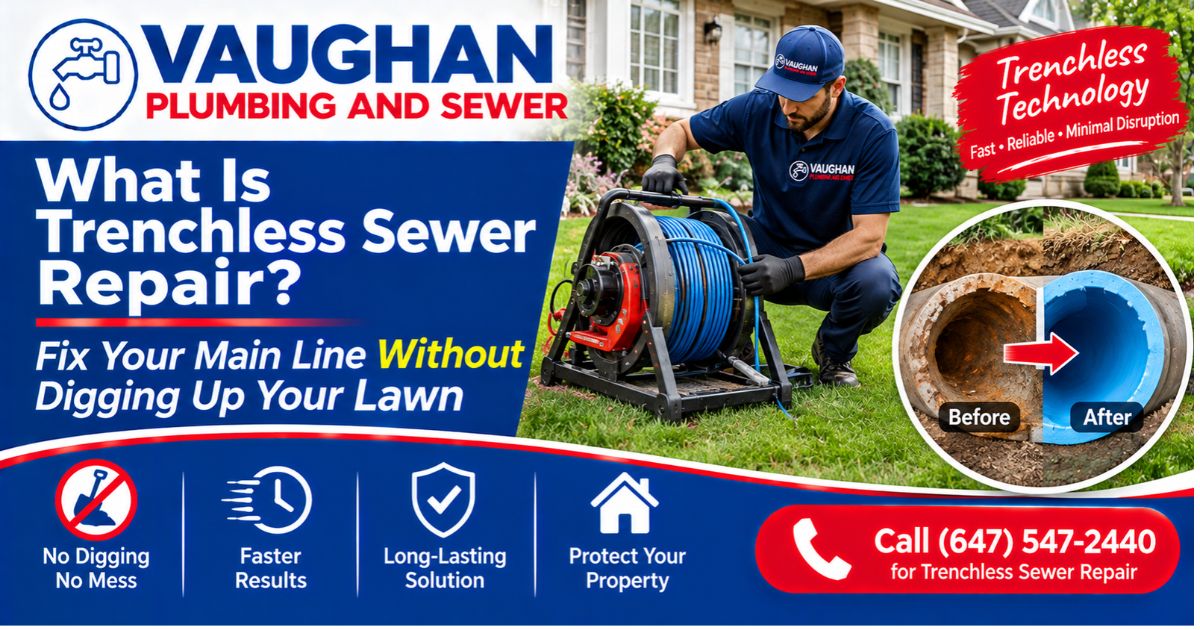
Having a damaged sewer line is stressful enough without having to dig up your front lawn, break up your driveway and/or dig up your garden. Trenchless sewer repair can help you avoid this! Instead of digging a large trench to access your damaged sewer line, plumbers can use specialist tools to access your sewer line through smaller access points. Depending on how damaged your sewer pipe is, plumbers can either repair the inside of the pipe or replace it altogether, without affecting much of your yard. This can be a great solution for homeowners in Vaughan to fix issues with cracked pipes, tree roots invading the pipe and leaking joints. While trenchless repairs can’t be used for everything, they can avoid lots of digging and fixing up your property. Read on to find out how trenchless sewer repairs work and the different methods plumbers use.
What Is Trenchless Sewer Repair in Vaughan, ON?
Trenchless sewer repair is a method of repairing/replacing your underground sewer pipes. Instead of digging a long trench, plumbers can gain access to your damaged pipes through existing cleanouts and/or small access points. They can then repair your sewer line from within the existing pipe or pull a new pipe through. Traditional sewer repair requires digging down to access your damaged pipe and replacing the damaged section. Trenchless repair means most of the work is done below ground. As there is no digging involved, this is sometimes referred to as no dig sewer repair in Ontario. This can be useful if your sewer pipes are running beneath landscaped gardens, patios, driveways, pathways and more. As it avoids having to dig up these areas, it can save you money. However, there will still need to be some small pits dug for some jobs and for certain pipe conditions.
How Does Trenchless Sewer Repair Work?
Trenchless sewer repair is actually quite simple. Once plumbers have identified the problem and prepared the damaged pipe, they will either line or replace your pipe. The most common steps taken during your trenchless sewer repair are:
Step 1 – Sewer Camera Survey
The first step is to understand what is going on below the surface. Plumbers will use a waterproof camera to look inside your sewer pipe.
This will help identify:
- Cracks, holes and damaged sections.
- Tree roots growing through the joints.
- Corrosion and damage to the inside of the pipe.
- Misalignment or separation of the joins.
- Collapsed sections and pooling.
Step 2 – Clear Pipe
Before any repair work is done, the technicians will need to clear the pipe. They may use hydrojetting to clear away any grease, sludge, dirt and build-up. They may also use specialized cutting tools to remove stubborn tree roots. This will allow them to see the damage and prepare the surface.
Step 3 – Decide On Repair Method
Once the pipe is clean, the plumber will decide what repair method to use. If your existing pipe is still structurally sound but is cracking or leaking, lining may be the right option. If your pipe is very damaged and needs replacing, pipe bursting entirely may be the best option. This will depend on the condition, material, size, alignment and accessibility of your pipe.
Step 4 – Complete Repair/Replacement
Depending on the method chosen, a liner will be installed inside your existing pipe or a new pipe will be pulled through. Most of the work will be done below ground through small access points.
Step 5 – Final Camera Survey
Once the repair has been completed, the technicians will carry out a final camera survey.
This will help ensure everything has been done correctly and the pipe is installed properly. They will also check that there are no blockages or issues.
What Are The Two Most Common Trenchless Sewer Repairs in Vaughan, ON?
There are two main types of trenchless repair. Pipe lining and pipe bursting. Both can help avoid lots of digging but will address different issues.
1. Pipe Lining (Cured-In-Place)
Pipe lining (also known as cured-in-place) is a method of repairing your existing sewer line by inserting a new pipe-like liner inside.
A flexible liner will be dipped in a special resin. The liner is then inserted into your damaged sewer pipe. The liner will be held in place against the existing pipe using an inflatable balloon or inversion method. The resin will then cure depending on the system being used (heat, steam or UV).
Once set the liner will harden to create a strong pipe inside your existing pipe. This will seal any cracks and joints, stop tree roots entering and create a smooth surface for the wastewater to travel through.
2. Pipe Bursting
If your existing sewer pipe is too damaged to line then pipe bursting can be used.
- Unlike pipe lining this method will replace your existing pipe.
- Small pits will be dug at suitable points along the sewer pipe.
- A specialised bursting head will be inserted into the existing pipe.
- The bursting head will be pushed through the damaged pipe bursting the existing pipe outwards into the surrounding soil.
A new pipe will then be pulled through, this is commonly made from HDPE (High Density Polyethylene).
When Should I Use Pipe Bursting:
Pipe bursting can be useful if your existing pipe is very damaged and needs to be replaced entirely. It can also be a consideration if homeowners want to replace their aged pipe with a new one without digging up the pipe. However, you will need to consider what is below ground, nearby structures, soil type and where the existing pipe is running.
Trenchless Sewer Repair Vs Traditional
Both methods can help repair your damaged main sewer pipe. However, the main difference is how plumbers gain access to the underground pipe.
Traditional sewer repair will require digging a trench along the damaged section. Once the pipe is uncovered the damaged section will be removed and replaced. This will then need to be filled back in and the area of lawn/driveway/pathway repaired.
Trenchless sewer repair uses specialist tools to do most of the work through small access points.
Below is a comparison between both methods:
| Comparison | Trenchless Sewer Repair | Traditional Sewer Repair |
| Excavation | Small access pits or existing openings | Larger trenches along the pipe |
| Lawn damage | Usually minimal | Can be extensive |
| Driveway disruption | Often avoided | May require concrete removal |
| Repair time | Often shorter | Usually takes longer due to excavation and restoration |
| Property restoration | Generally less work | May require landscaping and surface repairs |
| Suitable for | Pipes that meet the requirements for trenchless methods | Almost any pipe condition, depending on access and site conditions |
Trenchless repair can be useful if your sewer pipe is running underneath an existing garden, concrete driveway, patio or pathway.
Traditional excavation may still be needed if your pipe has completely collapsed, suffered from lots of ground movement or needs the gradient correcting.
5 Signs You May Need Trenchless Sewer Repair
Sometimes issues with your sewer pipe won’t cause a major backup. However, there are a few signs you should look out for.
1. Blocked Drains
Are your kitchen sink and/or multiple bathroom drains slow to empty?
This could be a sign that there is an issue further along your main sewer pipe. If you are having multiple fixtures causing drainage issues it is likely the issue is further along.
If you are consistently having blocked drains it is worth taking a closer look.
2. Sewer Backup
If you are having sewer backup through your basement floor drain, toilet or shower this is a more serious sign.
This could be caused by a blockage, tree roots or structural damage along your main sewer pipe. If you are having wastewater backing up into your home, try to avoid using any water and get a professional to come and look at it.
3. Sewer Smell
If you are constantly getting a sewage smell from your basement, yard or plumbing, it shouldn’t be ignored.
Cracked pipes/joints can cause sewer gases to escape. However, dry traps, venting issues and other plumbing issues can also cause unpleasant smells. Having a proper inspection can help identify the issue.
4. Wet or Green Patch In Yard
Have you noticed one area of your lawn is greener than usual? If your underground sewer pipe is leaking, wastewater will seep into the surrounding soil, causing wet patches or encouraging plant growth.
You may also notice soft ground or unexpected puddles. Whilst this doesn’t always mean there is an issue with your sewer, it is worth investigating.
5. Recurring Tree Roots
Tree roots will naturally grow towards moisture. Even a small gap in your underground sewer pipe can attract tree roots. Once they get inside they can get caught on debris restricting the flow of wastewater. This can cause further damage.
If you are constantly getting tree roots after having your drains cleaned there could be underlying damage to the pipe that will need a permanent repair.
When Should I Avoid Trenchless?
Whilst trenchless can help with many issues with your sewer pipe, there are some instances where traditional would be more practical.
- Fully collapsed pipe – To line your pipe, there needs to be an existing pipe structure to hold the liner in place. If the pipe has fully collapsed, it may not be suitable for lining. You may need to dig or replace the pipe.
- Badly misaligned pipe – If the sections have moved a lot a liner may not fix the issue.
- Sagging pipe (pipe belly) – This is when part of the pipe has sagged below the required gradient. This can cause wastewater to pool in the sagging section and cause solids to settle. Lining will not fix the gradient.
- Severely damaged – If the pipe has become too damaged for the chosen trenchless method to be safe, you may need to dig.
- Restricted Access – If there are nearby water, gas, electrical and other underground structures, it may not be possible to use trenchless equipment.
The best way to know if trenchless is suitable is to have a sewer camera survey and look at what is below your property. A good plumber should be able to tell you why a certain method is recommended. They shouldn’t guarantee they can fix any sewer pipe without digging.
Is Trenchless Sewer Repair Worth It For Homeowners In Vaughan?
For many homeowners, the main benefit is avoiding unnecessary damage to your property. Benefits include:
- Less damage to your property – As small access points are used, you often won’t have large areas of your lawn/driveway/garden disturbed.
- Faster – As there isn’t much digging, you’ll often have the job completed quicker.
- Cost saving on repairs – You may save on repairing your landscaping, concrete or other surfaces.
- Durable – With the liner or new pipe installed correctly, you’ll have a long lasting solution to your recurring sewer issues.
- Less disruption – Less work will be done, meaning it can be less of an issue for homeowners.
The cost will depend on how long, how deep, what material and how damaged your pipe is. How accessible it is and what repair method you need. Trenchless can be more expensive to start with. However, compare the full cost of the job, including any digging and property repairs.
How Long Will Trenchless Sewer Repair Take?
Most simple residential trenchless sewer repairs can be completed in a day. However, this can vary depending on:
- How long and deep the damaged sewer pipe is.
- What type and how bad the damage is.
- How much cleaning is required.
- If you’re having the pipe lined or burst.
- How accessible the sewer pipe is.
- How long the curing will take and what equipment is required.
Your plumber should give you an realistic timeframe once they have had a look at your sewer pipe.
How To Choose A Trenchless Sewer and Plumbing Repair Company In Vaughan
Trenchless sewer work will require specialist equipment and knowledge of the underground pipes. Choosing a plumber based on the cheapest quote can cause issues if the actual cause of the damage isn’t addressed. Consider the following when choosing a contractor:
- Ask for a sewer camera survey – The contractor should be able to show you where the damage is and explain what needs repairing.
- Understand the method – Ask why they recommend pipe lining or bursting for your sewer pipe. They should be able to explain why based on the survey.
- What is included? – Find out if cleaning, pits, installation, final survey and testing is included.
- Warranty – Ask what the warranty is on the workmanship and materials.
- Clear breakdown – Understand how much the repair will cost, including any digging and property repairs.
A good contractor will be able to explain your options, show you the condition of your sewer pipe and help you choose the right repair.
Get Your Sewer Line Repaired Without Unnecessary Digging
Just because your sewer pipe is damaged doesn’t mean you’ll have to dig up your lawn and driveway. Depending on the condition of your pipe, trenchless repair could be a more convenient option to repair your main sewer pipe with little effect on your property. If you’re having regular blockages, sewer backup, unpleasant smells or signs of a leak below ground, don’t leave it to get worse. Vaughan Plumbing & Sewer can carry out sewer camera surveys, sewer pipe repairs and replacements and pipe bursting services in Vaughan. We can assess your sewer pipe, explain your repair options and help find the right solution for your property.
Call us on 647-547-2440 to book a sewer inspection.
