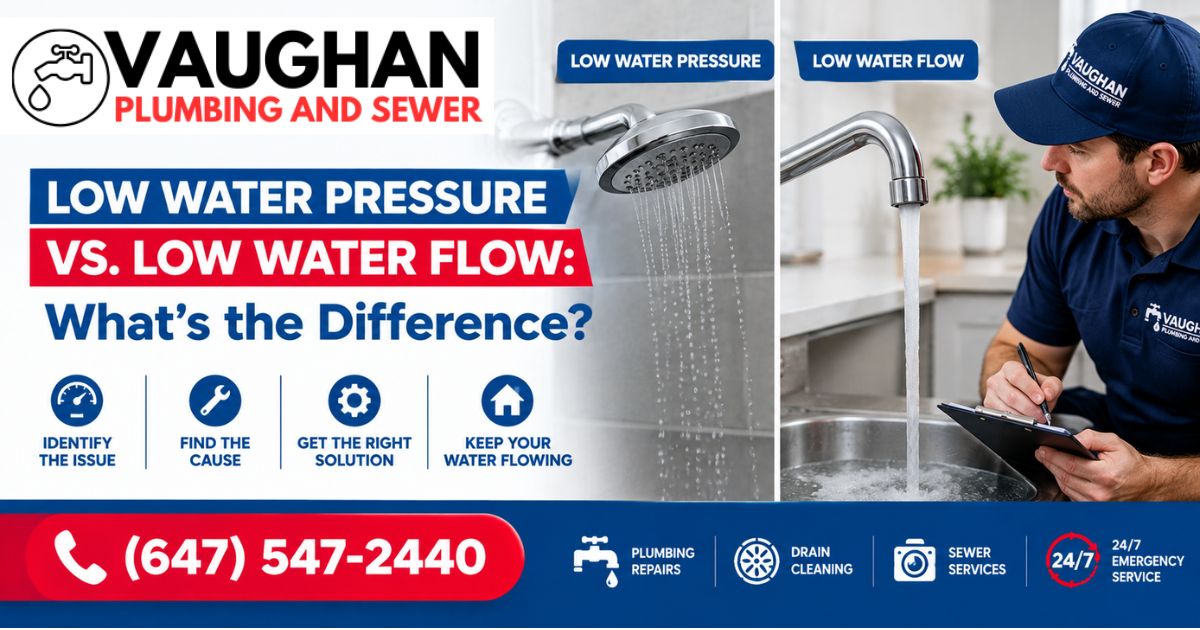
The shower seems to start well, but rather than getting a strong water stream, what you get is just a drop of water that cannot clean your body of dirt. While low water pressure is the first thing to be accused, what you actually have is low water flow, not pressure. Although these two terms seem to mean the same thing coming out of your tap, there are many differences between them.
As reported in the Canadian Infrastructure Report Card, 25% of water supply pipes that serve Canadians are in poor, fair or very poor condition. Low water pressure vs. low flow: knowing which one affects your tap will save you money in your quest for plumbing repair vs. replacement in Vaughan. Get ready to find out which is affecting you.
What is Water Pressure and How Does It Work?
Water pressure can be defined as the pressure needed to push water through your pipes. The pressure is normally measured in pounds per square inch (PSI). Water pressure is comparable to the air pressure in the tire of a bicycle. High pressure being high means that there is a lot of force on the walls of the pipes, whereas low pressure makes everything slow.
The water pressure available through the municipal water system in Ontario to your home will range from 40 to 80 PSI. Water will get into your home through the shutoff valve and pressure-reducing valve to the kitchen and bathroom. The problem with low-pressure water at home will be that you will not be able to fill your washing machine.
What is Water Flow and Why Does Volume Matter?
Flow is used to calculate the quantity of water that is flowing through the pipe or plumbing fixture at a particular time. The flow rate is measured in gallons per minute or litres per minute by plumbers. Pressure is the force, while flow is the volume of water which is used for washing dishes or taking a shower.
Take an example where you have a garden hose, and you apply your thumb to the nozzle of the hose. The water sprays into the air, and the distance covered by the water increases. This is due to the increase in pressure, and not because of the volume of water. Once you remove your thumb from the hose, the water will splash close to your feet; however, the bucket will fill up quickly.
Low Water Pressure vs Low Flow: The Direct Comparison
Comprehending the relationship between force and volume is easy. Here is a brief comparison of the two:
| Property | Water Pressure | Water Flow |
| What It Measures | The force pushing water through pipes | The physical volume of water coming out |
| Measurement Unit | Pounds per Square Inch (PSI) | Gallons per Minute (GPM) |
| Everyday Analogy | Air pressure inside a tire | Total gallons of water inside a bucket |
| Scope of Problem | Usually affects the entire house at once | Often isolated to a single faucet or room |
| Primary Cause | PRV issues, main line leaks, municipal drops | Mineral scale, narrow pipes, clogged aerators |
| Best Solution | Adjusting PRVs or fixing main line supply | Descaling fixtures, cleaning aerators, repiping |
Signs You Have Low Water Pressure Across Your Home
You will encounter such issues within your home where there is low pressure, especially in more than one room.
- Drops in Pressure: Switching on the tap in your kitchen leads to an instant decline in the pressure of the shower in your bathroom.
- Gauge Pressure: The pressure gauge for your outdoor hose shows a pressure that is less than 40 PSI.
- Appliance filling up: It takes a long time before your dishwasher and washing machine fill up completely.
- Second floor pressure: Second floor bathrooms have low pressure compared to basement bathrooms due to gravity.
Signs You Have Low Water Flow at Specific Taps
In case of good pressure but bad flow in the system, the problem is usually confined to specific fixtures.
- Burst followed by trickling: Water gushes out strongly for 2 seconds and then drops down to trickling.
- Isolated fixtures: The kitchen sink has poor flow while the nearby powder room sink provides good flow.
- White mineral crust: White chalky mineral crust is present on your shower head nozzles and faucet screens.
- Good static pressure: The pressure gauge reading shows 50 PSI on the outside tap, but there is poor flow in indoor sinks.
Common Causes Behind Poor Water Performance
There may be some unseen factors within your system that affect how well water flows or the strength of the force it has. These are the problems you should consider.
Problematic Pressure Reducing Valve
A bell-shaped valve made from brass is used to lower the high pressure of city pipes to a household pressure. This is mostly found near the household water meter. If the springs in it break or get clogged with dirt, it could jam itself and stop any force from coming in.
Mineral Build-Up or Clogged Aerator Signs
Water that is considered hard has mineral deposits such as calcium and magnesium in it. While passing through faucets’ aerators, they precipitate to form a crust. Some signs include spraying to one side, unequal spray, or decreased flow in only one faucet even though house pressure is okay.
Galvanized Corroded or Narrow Pipes
Homes in the Greater Toronto Area built prior to the 1970s use galvanized iron pipes. Rust builds up internally for many years, resulting in a reduction of the internal diameter of the pipe. Normal static pressure exists when all taps are shut, but once any tap is opened, there is a huge restriction and no volume flow.
Main Shutoff Valves Partially Open
Home renovation professionals or plumbers may shut off the main shutoff valve while doing repairs. If the main ball valve or gate valve is not opened fully, then water will be forced to flow through a small opening.
How to Test Water Pressure and Flow at Home
Expensive equipment is not required in order to determine your plumbing system’s condition. You can complete two easy tests in less than ten minutes.
- Test the Pressure With a Gauge: Get yourself a normal water pressure gauge from any local hardware store. Screw the gauge to your outdoor hose spigot or washing machine cold water tap. Open the tap fully while ensuring that all other taps at your home are closed. The ideal reading for a household is between 45 and 65 PSI.
- Take a Bucket Test for Flow: Grab yourself a one-gallon bucket and position it underneath either your kitchen tap or showerhead. Open the tap fully with cold water and measure the time the container will take to get filled. Then divide 60 by the seconds it took, and you’ll know your water flow rate GPM). Kitchen faucets usually provide about 1.5 to 2.2 GPM.
Now comparing both results will tell you the whole story. High PSI and low GPM means a blockage in pipes or a clogged fixture. Low PSI and low GPM mean a problem with the main line or valves.
Simple Troubleshooting Solutions for Homeowners
When you have found out whether you have a pressure problem or a volume problem, then you are halfway to solving it.
- Cleaning the Faucet Aerators: Use the pliers and the rag to unfasten the small screen that is fixed at the base of your tap. You need to soak this screen in white vinegar for one hour before cleaning it with a toothbrush.
- Main Valve Check: The main water meter should be checked in the basement of your home. Make sure that the handles of both valves are parallel to the piping.
- Tank Flushing: The formation of deposits in the lower part of your water heater stops hot water from flowing to other rooms in your house. Tank flushing is done every year, since this removes the rust and sediment.
- Pressure Valve Installation: When your pressure-reducing valve fails and leads to low pressure in all parts of your house, a plumber can install a new pressure-regulating device.
Restore Full Water Flow and Pressure in Your Vaughan Home Today
Knowing the difference between water pressure and volume enables you to address plumbing problems with complete understanding. Minor fixture cleaning may be sufficient to fix volume problems for one tap, but pressure problems for an entire house should be addressed by a professional. If you seek professional advice for water line diagnosis or repair options, contact us at Vaughan Plumbing and Sewer.
Our plumbing service helps you with your constant pressure issues and pipe clogs in the area of Vaughan, Ontario, Canada, to ensure water runs smoothly through every faucet.
Having trouble with water pressure in your house? We can help! Call us at (647) 547-2440 or visit our website at vaughanplumbingandsewer.ca for your appointment.
